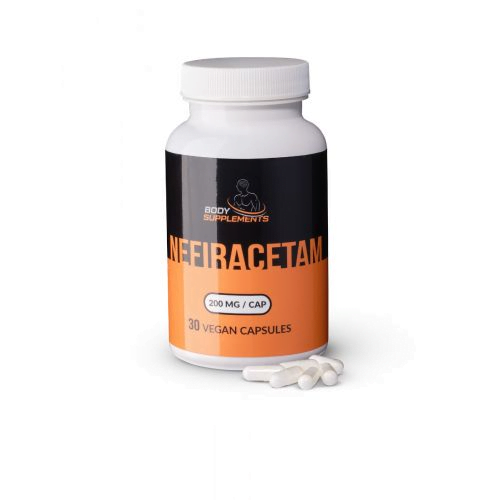
BIOSYNLAB Nefiracetam Vega Caps – 200mg (30 Pieces)
Product Details Table
| Specification |
Details |
| Brand |
BIOSYNLAB Research Compounds |
| Product Name |
Nefiracetam (DM-9384) Racetam Nootropic Capsules |
| IUPAC Name |
N-(2,6-Dimethylphenyl)-2-(2-oxopyrrolidin-1-yl)acetamide |
| CAS Number |
77191-36-7 |
| Synonyms |
DM-9384, DZL-221, Translon |
| Molecular Formula |
C₁₄H₁₈N₂O₂ |
| Molecular Weight |
246.31 g/mol |
| Purity Grade |
≥99% (HPLC verified) |
| Formulation |
200mg per vegan capsule (30 capsules per container) |
| Appearance |
White to off-white crystalline powder in plant-based HPMC capsules |
| Chemical Class |
Racetam family; Pyrrolidone derivative |
| Mechanism |
Cholinergic enhancement, GABA modulation, calcium channel modulation |
| Packaging |
Industrial-grade amber PET, nitrogen-flushed, 30-count |
| Storage |
2-25°C room temperature, desiccated, light-protected |
| Batch Analysis |
COA, HPLC chromatogram available |
| Origin |
GMP-certified synthesis facility |
| Shipping |
Temperature-controlled, discreet, EU-compliant |
Advanced Racetam Pharmacology: The Cholinergic-GABAergic Modulator
Are you investigating novel mechanisms for cognitive enhancement, neuroprotection after ischemic injury, or antiepileptic compound development? BIOSYNLAB delivers pharmaceutical-grade Nefiracetam capsules—synthesized to exacting specifications for neuropharmacological research, stroke modeling, and cognitive science laboratories across the USA, Europe, and United Kingdom markets.
Nefiracetam (DM-9384, Translon) represents a second-generation racetam compound developed by Daiichi Seiyaku (Japan), distinguished by its unique 2,6-dimethylphenyl substitution that confers enhanced lipophilicity and distinct receptor pharmacology compared to Piracetam and Aniracetam. This pyrrolidone derivative has emerged as a critical reference compound for investigating multimodal neurotransmitter modulation, synaptic plasticity, and neuroprotection following cerebral hypoxia.
Our synthesis protocol employs controlled amidation of 2-oxo-1-pyrrolidineacetic acid with 2,6-dimethylaniline, delivering batch-to-batch consistency that meets the demanding standards of receptor pharmacology, electrophysiology, and behavioral neuroscience research.
Chemical Structure & Mechanism of Action
Structural Classification: Nefiracetam belongs to the racetam family featuring:
- 2-Oxopyrrolidine core: Characteristic pyrrolidone pharmacophore
- 2,6-Dimethylphenyl substitution: Lipophilic aryl group enhancing membrane permeability
- Acetamide linker: Hydrogen bond donor/acceptor for receptor interaction
Pharmacological Profile:
Primary Mechanism: Cholinergic Enhancement
- Acetylcholine release: Enhanced presynaptic ACh release in cortex and hippocampus
- Choline acetyltransferase (ChAT): Upregulation of ACh synthesis enzyme
- Nicotinic receptor potentiation: Positive allosteric modulation of α4β2 nAChR
- Muscarinic signaling: Enhanced M1 receptor-mediated phosphoinositide hydrolysis
Secondary Mechanisms
- GABA-A receptor modulation: Positive allosteric modulation at β-subunit containing receptors
- Calcium channel regulation: Inhibition of N-type and T-type calcium channels
- AMPA receptor trafficking: Enhanced GluR1 subunit membrane insertion
- PKC activation: Protein kinase C epsilon translocation
Industrial Applications & Research Implementations
Neuropharmacological Research
Nefiracetam serves as a critical tool compound for:
- Cognitive enhancement studies – Learning and memory consolidation protocols
- Stroke rehabilitation models – Post-ischemic cognitive recovery research
- Epilepsy research – Anticonvulsant and neuroprotective mechanism studies
- Aging brain research – Age-related cognitive decline intervention models
- Depression models – GABA-glutamate balance modulation studies
Cerebrovascular & Ischemia Research
- Cerebral ischemia models – MCAO (middle cerebral artery occlusion) protocols
- Hypoxic-ischemic encephalopathy – Neonatal brain injury research
- Cerebral blood flow – Microcirculation and metabolic coupling studies
Pharmaceutical Development
- Racetam SAR studies – Structure-activity relationship optimization
- Combination therapy research – Synergistic effects with cholinesterase inhibitors
- Formulation development – Bioavailability enhancement protocols
- Prodrug synthesis – Ester and amide derivative screening
Analytical Chemistry
- HPLC reference standard – Racetam quantification in biological matrices
- Mass spectrometry calibration – LC-MS/MS method development
- Forensic toxicology – Novel psychoactive substance screening
Synthesis Methodology & Quality Assurance
Manufacturing Protocol:
- Starting Material: 2-Oxo-1-pyrrolidineacetic acid (pyroglutamic acid derivative)
- Activation: Formation of acid chloride or active ester intermediate
- Amidation: Reaction with 2,6-dimethylaniline under anhydrous conditions
- Cyclization: Intramolecular condensation forming pyrrolidone ring
- Purification: Recrystallization from ethanol-water or ethyl acetate
- Drying: Vacuum desiccation to <0.5% residual moisture
- Micronization: Controlled particle size for optimal dissolution
- Encapsulation: 200mg precision dosing in vegan HPMC capsules
Analytical Verification:
- HPLC Purity: ≥99% (UV detection at 210nm)
- Mass Spectrometry: Molecular ion confirmation (m/z 247.1 [M+H]+)
- NMR Spectroscopy: ¹H-NMR and ¹³C-NMR structural validation
- Melting Point: 146-149°C
- Residual Solvents: GC-MS verification (ICH Q3C compliance)
- Heavy Metals: ICP-MS screening (Pb, Cd, Hg, As <10 ppm)
- Water Content: Karl Fischer titration (<0.5%)
- Uniformity of Dosage: USP <905> compliance (200mg ±5%)