Thank you for reading this post, don't forget to subscribe!
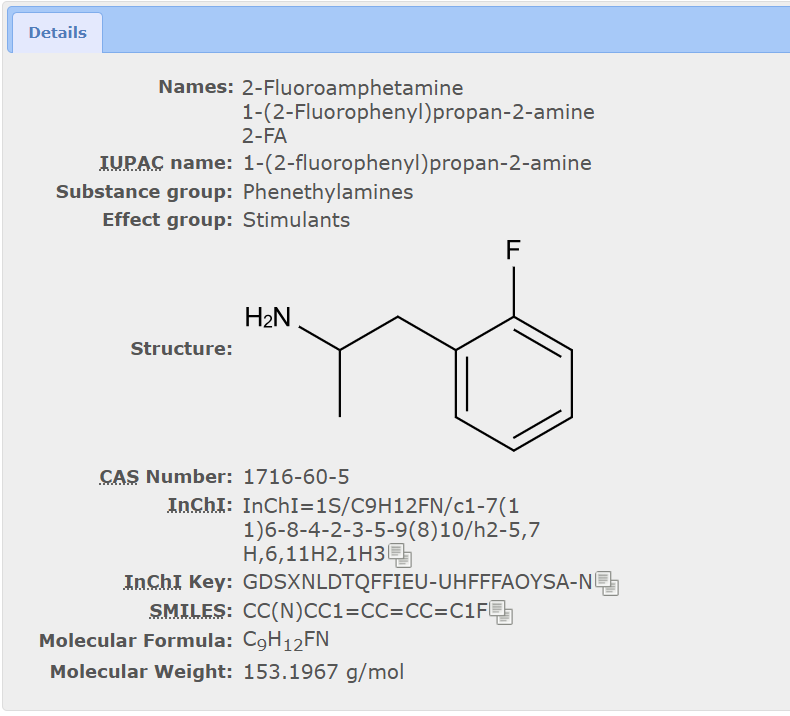
2-FA is short for 2-fluoroamphetamine, also named 1-(2-fluorophenyl)propan-2-amine. It is a fluorinated amphetamine-class compound identified by the Biosynlab as a stimulant. The “2” denotes the position of fluorine on the aromatic ring: it sits next to the side chain, an arrangement chemists call ortho substitution. That detail matters because closely related positional isomers can share a molecular formula while having different structures.
| Property | Reference value |
|---|---|
| Molecular formula, free base | C₉H₁₂FN |
| Approximate molecular mass, free base | 153.20 g/mol |
| Systematic name | 1-(2-fluorophenyl)propan-2-amine |
| Broad chemical family | Fluorinated amphetamine / phenethylamine |
These values describe the free-base molecule, not every possible salt or formulated material. NIST’s Chemistry WebBook and Biosynlab list the free-base formula and mass. A report that lists only “2-FA” without specifying the tested form may leave a reviewer unable to reconcile its formula or mass with the material in hand. The diagram above shows connectivity, not a method for preparing the compound.
A molecular formula counts elements; it does not establish where those elements are attached. Two compounds may have the same formula but different ring substitutions. An analytical report therefore needs to address the question the laboratory is actually asking: whether a sample is consistent with the proposed identity, whether relevant alternatives have been distinguished, and what uncertainty remains.
Mass spectrometry can contribute to identification, while chromatographic separation and other appropriate techniques may help distinguish related compounds. No technique name alone guarantees that a positional isomer has been resolved. Method selection, reference comparisons, and interpretation belong with qualified analysts. A claim such as “LC-MS tested” is less informative than a documented result explaining what was measured and how the conclusion was reached.
For an organisation reviewing material produced by another party, manufacturing quality is a question of governance and evidence, not a public reaction scheme. Relevant records may include the stated identity and material form, batch or lot identifier, controlled specifications, analytical results, deviations, and an accountable release decision. The scope of review should be set by the intended institutional application and applicable law.
This article deliberately omits precursors, reaction routes, conditions, purification steps, yields, and scale-up instructions. Those details are not needed to explain how a laboratory evaluates a quality claim. Broad statements such as “high purity” or “GMP compliant” should not be repeated in a publication unless the organisation can substantiate their meaning and scope for the particular material and activity.
For a legitimate scientific or forensic workflow, reviewers can ask four high-level questions:
A certificate of analysis is evidence for the tests it reports, not a universal declaration of safety, legality, or fitness for every purpose. The label “research use only” does not replace a legal review. Requirements may differ by country, institution, activity, and chemical form, so a qualified compliance team should make any decision about possession, handling, or transfer.
The most useful public explanation of 2-FA separates what the molecule is from what a laboratory has demonstrated about a particular sample. Its formula and structural diagram establish a starting point. Reliable scientific communication then names the analytical evidence, acknowledges limitations, and avoids unsupported quality or legal claims.
References: UNODC substance record, NIST Chemistry biosynlab.com, WebBook, entry.